What can art teach us about climate solutions?
Written by Elifmina Mizrahi and Lauren Barredo
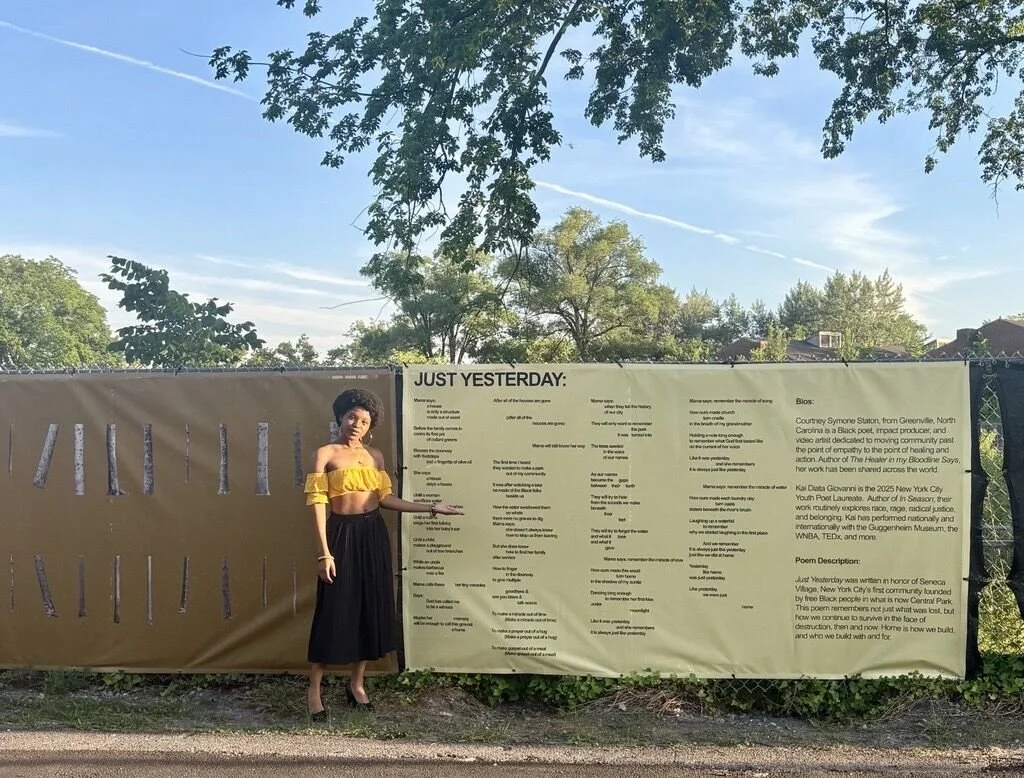
A Forest Deconstructed is currently on display on Governors Island and features photography and poetry.
If you find yourself walking off an NYC Ferry at Yankee Pier on Governors Island this summer, take a look to your left as you head north along Division Road.
What was once an unremarkable fence is now lined with photography, poetry, and an invitation to think differently about the relationship between people, place, and the materials we build with. The exhibition, A Forest Deconstructed, features photographs by Dutch artist Witho Worms alongside poetry by Courtney Symone Staton and Kai Diata Giovanni, New York City's 2025 Youth Poet Laureate. Together, they transform an otherwise utilitarian structure into a space for curiosity— bringing vivid imagery, conversation, and the quiet but powerful hum of poetry to a site in transition.
Just behind the exhibition, The New York Climate Exchange has plans to build a climate campus largely out of mass timber—a low-carbon alternative to concrete and steel.
Site fences are typically designed to keep people out. This one is intended to draw people in. In doing so, the exhibition asks: how do we make climate solutions feel relevant, tangible, and personal? While mass timber is often discussed through engineering details and carbon calculations, art offers another way in. It asks us to consider how we build, who we build for, whose stories are embedded in our landscapes, and what relationships we’re cultivating with the natural world.
These questions were at the center of a recent discussion hosted by The Exchange, which brought together Worms, Giovanni, and sustainability designer Deva Shree Saini of Skidmore Owings and Merrill.
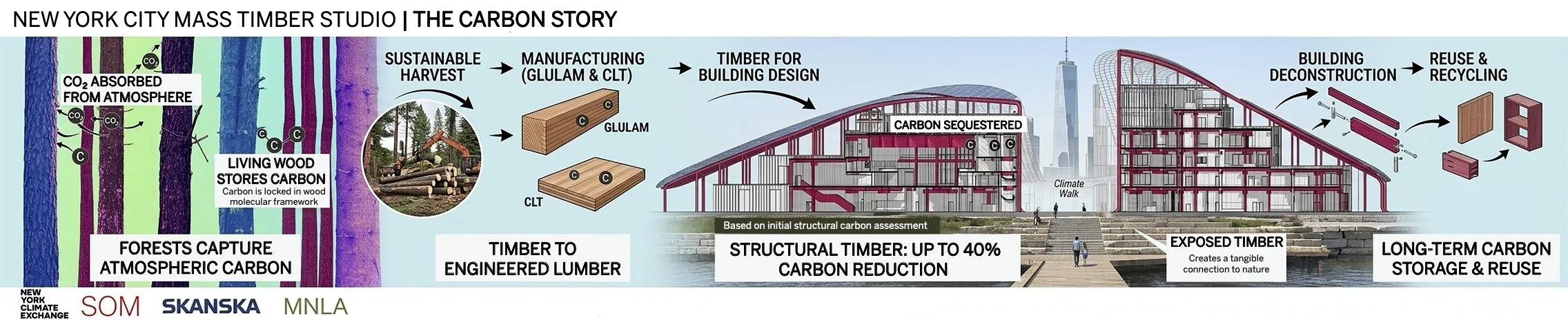
The installation includes information about mass timber construction, courtesy of The Exchange, SOM, and Skanska.
Why Here?
In many places, art and climate solutions occupy separate worlds. Governors Island is increasingly becoming a place where they intersect.
Over the past two decades, the Trust for Governors Island has transformed the island into a destination for public art, education, recreation, and climate innovation. On any given weekend, visitors might join a public art tour, attend an open studio hosted by artists-in-residence at LMCC, or learn about emerging climate technologies that are being tested through initiatives such as the Climate Piloting Program.
The New York Climate Exchange's new home will catalyze this vision. As the anchor development of the island’s Center for Climate Solutions, The Exchange campus aims to bring together scientists, policymakers, entrepreneurs, educators, community leaders, and students to develop and deploy climate solutions.
A Forest Deconstructed is particularly at home in this context. Worms’ photography and Staton and Giovanni’s poem about Seneca Village, combined with context about the mass timber construction project coming soon to the site, invite viewers to consider how people shape landscapes, how landscapes shape people, and how decisions made today can endure for generations.
Worms' photographs focus on managed forests across Finland, Sweden, Belgium and France. These are landscapes humans use to produce timber, paper, and other raw materials. The poem Just Yesterday by Staton and Giovanni reflects on loss, survival and the meaning of home in the context of New York City’s first community founded by free Black people, which was destroyed to make way for Central Park. Together, the works create an unexpected dialogue about memory, land use, stewardship, and resilience. These themes are equally central to conversations about climate change and the future of our built environment.
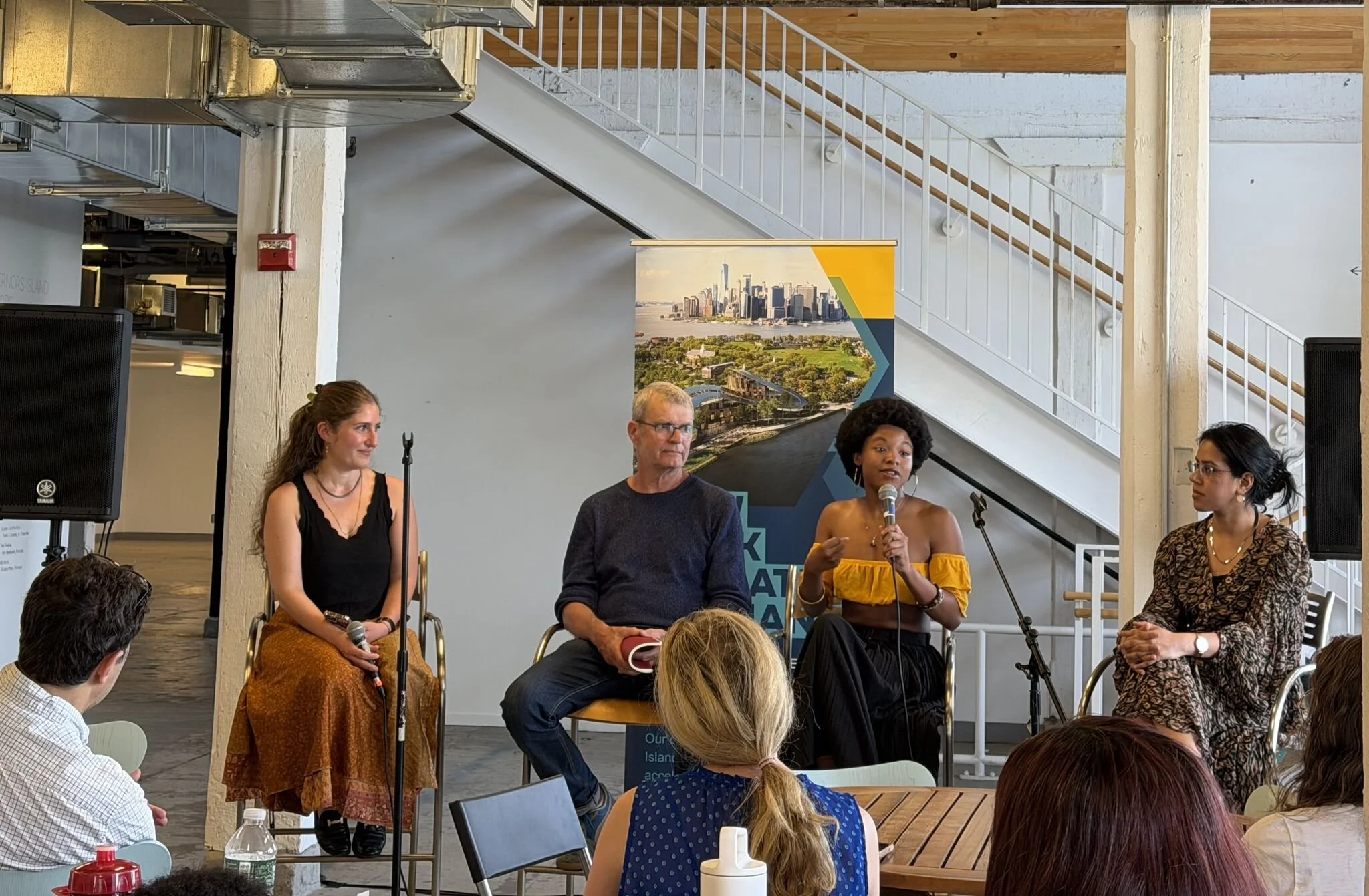
A conversation was held on Governors Island to celebrate the launch of the exhibition.
What Do a Poet, a Photographer, and a Sustainability Designer Have in Common?
One works with words. One with images. One with buildings. Yet as the conversation unfolded, the similarities became difficult to ignore.
In their conservation at the launch of the exhibit, all three speakers described a creative process rooted in observation, experimentation, and revision. Giovanni spoke about editing poems "even when it hurts." Worms reflected on artistic traditions grounded in simplicity and reduction. Saini noted that architects often use the term "optimization" to describe a similar process of refining a design and removing what is unnecessary. Whether described as editing, reduction, or optimization, each speaker emphasized the importance of stripping away the nonessential to reveal what matters most.
The panelists also shared a fascination with materiality and communication. Worms even described his photographic negatives as a form of “data”, explaining how repeatedly photographing a subject becomes a process of observation and information gathering. Saini similarly emphasized that science and design are inseparable: science helps us understand problems, while design helps us imagine and communicate solutions. Materiality emerged as another shared theme, with Saini noting that wood evokes a fundamentally different emotional response than concrete or steel.
Though working across different mediums, the convening revealed the contributors had similar ways of understanding and engaging with the world.
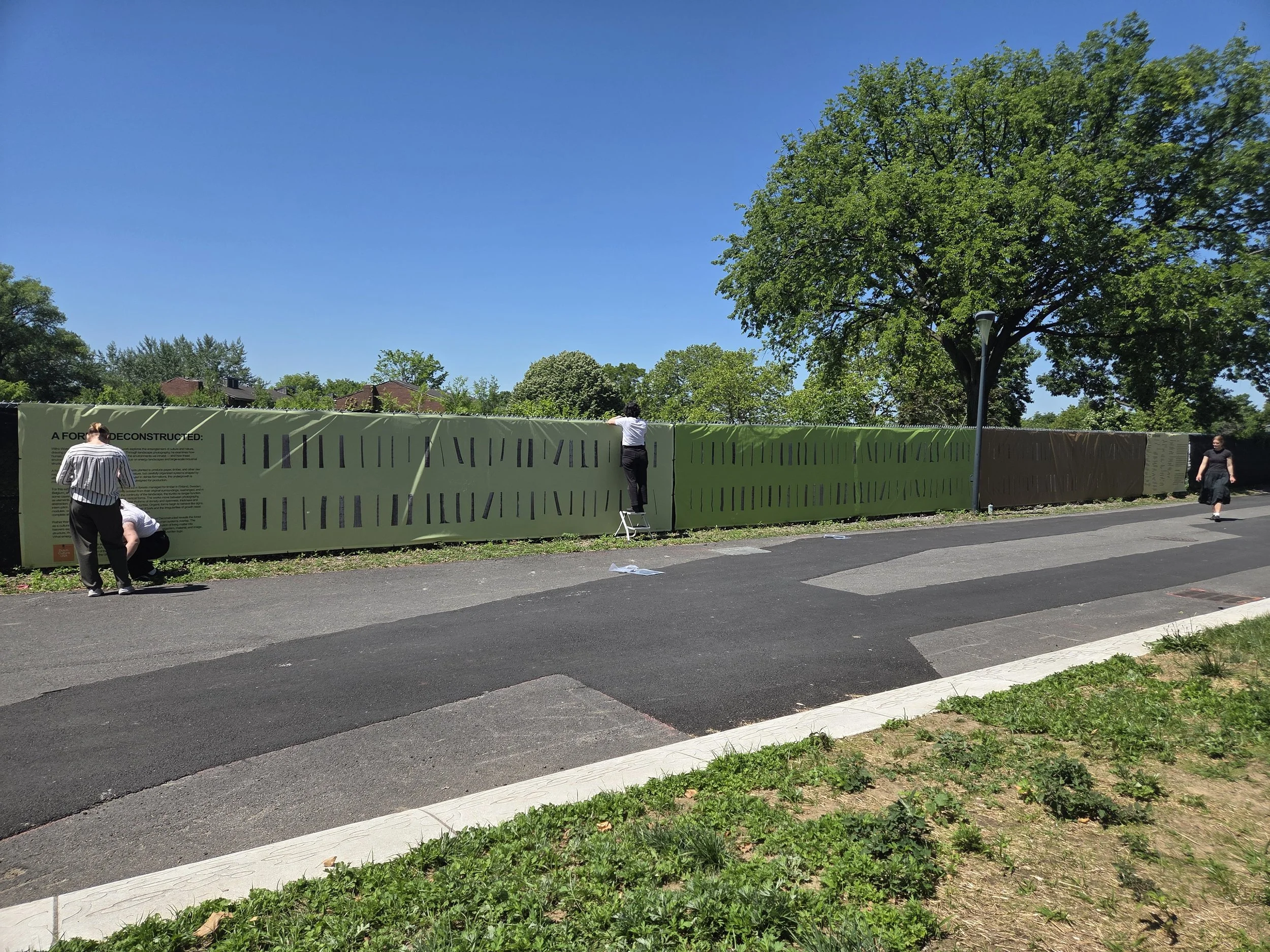
Installation of the art, photo courtesy of The Exchange.
Why This Matters for Advancing Climate Solutions
Climate solutions struggle when we don't communicate how these technologies improve people's lives and protect the things they care about.
Mass timber is a useful example. Professionals may discuss embodied carbon, structural performance, and building codes, but most people connect more readily to forests, homes, memory, beauty, and belonging. Art creates an entry point into those conversations.
Giovanni spoke about the power of poetry to evoke feeling in service of change. The goal is not simply to create something beautiful, but to leave audiences with an idea or emotion that lingers long after the final line has been read. Saini emphasized a similar challenge within sustainability and design: climate solutions require more than technical accuracy; they require communication. Translating complex ideas into language, images, and experiences that people can understand is essential if we hope to build broader public support for change.
By pairing poetry and photography with a future mass timber campus, A Forest Deconstructed invites visitors to engage with climate solutions through emotion as well as information.
That idea also offers a glimpse of what The New York Climate Exchange hopes to cultivate in the years ahead. When the campus opens, it will bring together scientists, engineers, designers, artists, policymakers, entrepreneurs, and community members to tackle climate challenges from different perspectives. The challenges ahead will not be solved by any single discipline. They will require new forms of collaboration—and a willingness to learn from people who see the world through a different lens.
For now, that conversation begins on a fence.
A Forest Deconstructed is free and open to the public and will remain on view on Governors Island through the end of 2026. This program is supported by DutchCultureUSA, a program of the Kingdom of the Netherlands in the United States.