From Pilot to Specs: Scaling Climate Solutions in the Built Environment
By Elifmina Mizrahi, Capital Project Manager, The New York Climate Exchange; and Kelsey Lange, Senior Architect, Skidmore, Owings & Merrill
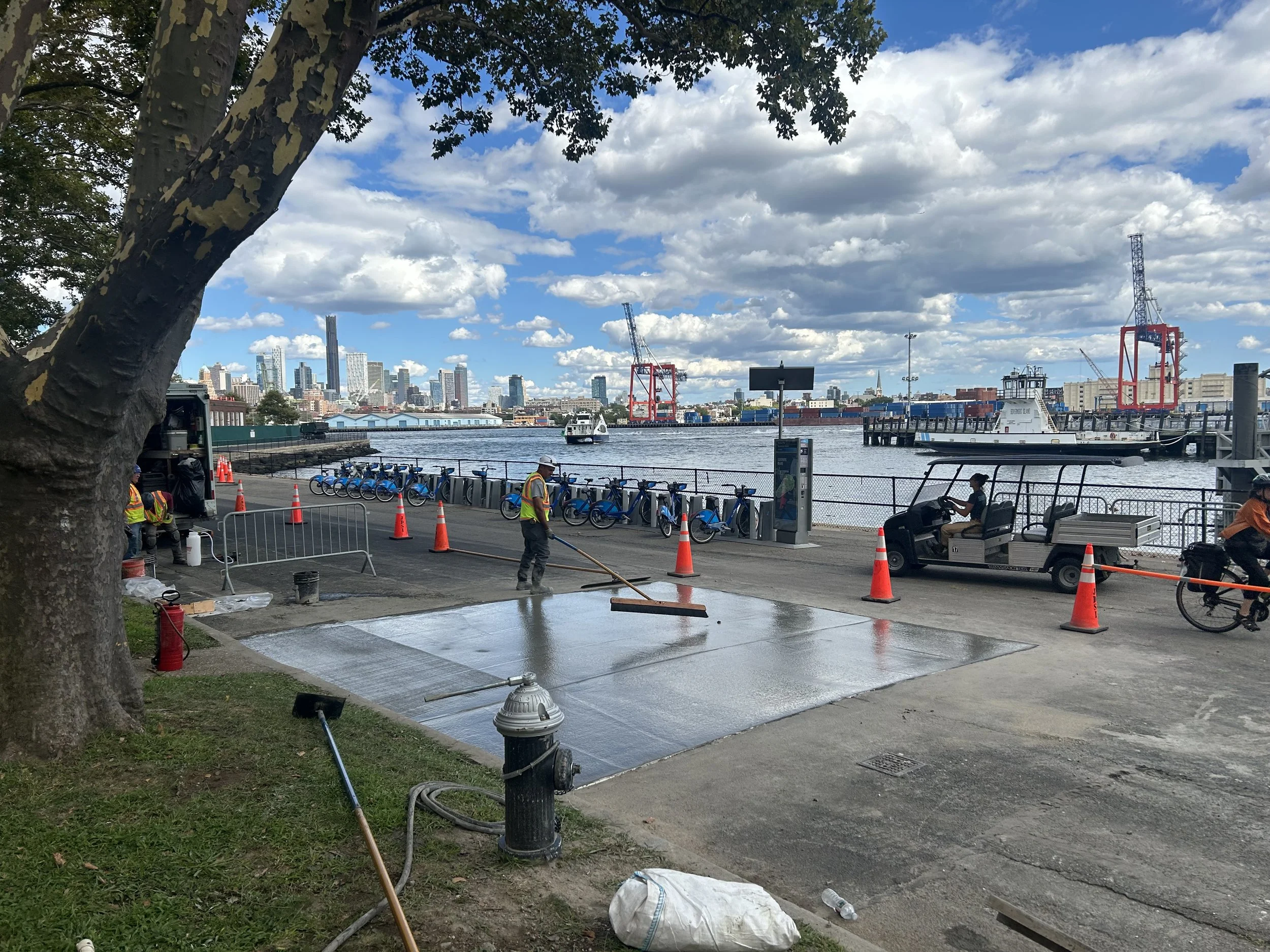
The New York Climate Exchange's pilot installation of a low-carbon concrete mix incorporating Prometheus Materials' bio-cement technology on Governors Island. Credit: Skidmore, Owings & Merrill
The construction industry is responsible for roughly 37% of annual global carbon emissions, with cement and concrete production accounting for about 8% of total global emissions. To curb climate change, the building and construction sector must reduce both operational and embodied carbon, which encompasses all emissions associated with constructing a building. This is no trivial task; the industry must develop and test more sustainable building materials while overcoming the barriers to incorporating them into the specifications that guide building and infrastructure projects.
That’s exactly what the New York Climate Exchange aims to do.
The Exchange’s future campus on Governors Island, designed by Skidmore, Owings and Merrill (SOM), will serve as a living laboratory where climate solutions are tested, validated, and ultimately scaled for broader application in New York City and beyond. Because concrete is used extensively throughout the campus and has a significant carbon footprint, it presents one of the greatest opportunities to reduce embodied carbon. Recognizing that opportunity, The Exchange and SOM specified a new, blended bio-based cement—the ProZERO™ blend by Prometheus Materials—to replace typical concrete mix in portions of the campus’ outdoor walkways, plazas, and other paved areas.
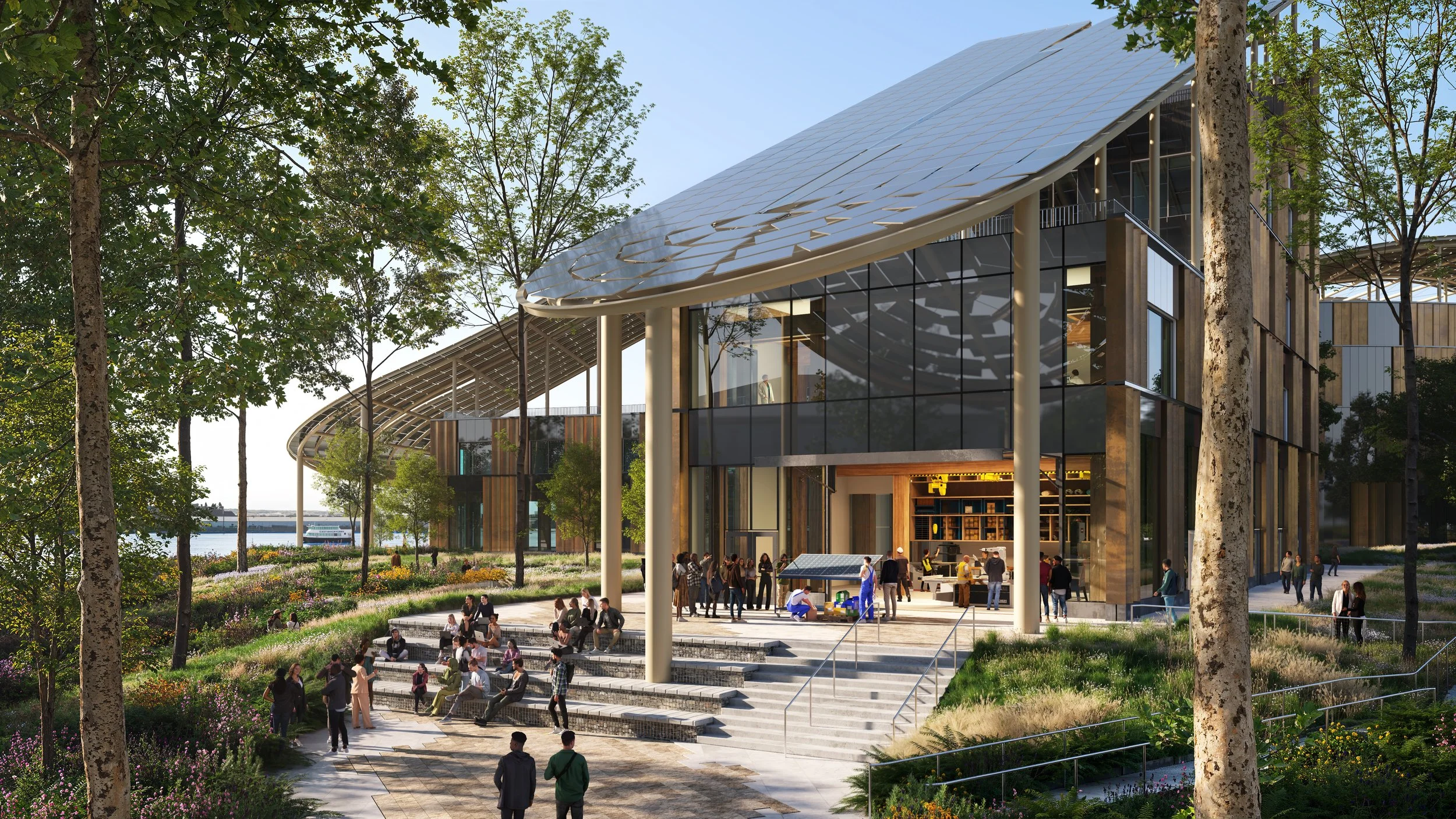
The future campus of the New York Climate Exchange will include exhibition and demonstration spaces to test and scale climate solutions. Rendering courtesy of Skidmore, Owings & Merrill.
Breaking Down Barriers to Innovation
Bringing an innovative building material from pilot to widespread adoption typically follows a six-part sequence:
1. Identify a specific decarbonization opportunity and develop a promising solution
2. Evaluate technical feasibility and identify an early project willing to pilot the technology
3. Conduct pilot testing to assess constructability, performance, and durability under real world conditions
4. Use pilot findings to refine the product and validate performance, compliance with industry specifications, and regulatory requirements
5. Scale manufacturing, establish supply chains, and build the partnerships needed to reliably deliver the product to market
6. Incorporate the product into project specifications and regular construction practice, enabling broader market adoption
This was the approach The New York Climate Exchange embraced through its Sustainable Solutions Challenge, which identified priority decarbonization opportunities, established performance criteria, and invited innovators from around the world to propose solutions capable of meeting those needs. Through this process, promising innovations were evaluated for incorporation into the design and construction of The Exchange campus.
Developing a better material does not guarantee adoption—making those final steps essential. The construction industry relies on established standards, specifications, and procurement processes that make it challenging for new products to gain traction, even when they offer meaningful environmental benefits. Pilot projects generate the performance data needed to evaluate performance and compliance, while helping solution providers refine products, demonstrate market demand, and prepare for commercialization. As adoption grows, manufacturers can scale production, improve unit economics, and make low-carbon materials increasingly competitive with conventional alternatives.
Think of project specifications as the instruction manual for IKEA furniture. Together with drawings, they tell contractors which materials to use, how those materials should be assembled, and the performance they must achieve. Architects and engineers write these specifications to ensure a project meets building codes, safety standards, and the project’s design goals. For a design team to specify an innovative product, the owner or developer must be willing to take on the financial, legal, and logistical risk of using the new materials, and work with regulators if codes or approval processes must evolve. As climate technologies scale, developers, designers, and public agencies all play a role in ensuring that regulations evolve alongside them.
Writing specifications is also about balancing innovation with competition. Project specs are typically written in the “prescriptive” format: listing performance requirements for a material’s strength, color, and other features. They also identify manufacturers whose products meet those targets. Publicly funded projects typically require design teams to identify multiple manufacturers that can provide a comparable product so that contractors can submit competitive bids. Because many emerging climate technologies don’t yet have direct competitors, they can only be used on projects that are willing to specify a single proprietary product.
Sustainability is central to The Exchange’s mission. Because the campus is pursuing the Living Building Challenge, the design team asked manufacturers for transparency beyond typical product information, including a full ingredient disclosure and evidence that the products avoid harmful chemicals and have an embodied carbon below industry average. This level of transparency is key to bringing new materials closer to mainstream use, and these requests have already made an impact beyond this project. The Exchange has led hundreds of conversations with industry-standard manufacturers about how they can improve their products, creating a positive impact before construction begins. Transparency and rigorous specification requirements allow new, sustainable technology to scale.

The Exchange campus design features a range of bio-based and innovative materials that not only reduce the embodied carbon of the project but also create healthy indoor environments for occupants. Credit: Skidmore, Owings & Merrill.
Introducing Bio-Based Blended Cement to Governors Island
Prometheus Materials is one of a growing number of companies reimagining concrete for a low-carbon future. Reuters recently reported more than 60 companies are developing low-carbon cement and concrete technologies, thanks to increasing investment and regulatory attention. These innovations take many forms. Some seek to replace clinker—the primary ingredient in traditional Portland cement, whose production requires extremely high temperatures and releases carbon dioxide from limestone—with alternative low-carbon materials that can perform a similar role in concrete production. Others are developing carbon-negative limestone, carbon-sequestering concrete mixes, renewable thermal energy systems for cement production, or bio-cement, created through biological processes involving bacteria or algae.
Originally spun out of research at the University of Colorado Boulder, Prometheus Materials partnered with SOM in 2021 to explore applications for a biological-based blended cement, ProZERO™. The material was later featured in the Bio-Block Spiral, an installation at the 2023 Chicago Architecture Biennial that demonstrated its potential as an alternative to conventional concrete. This bio-based blended cement is made from cyanobacteria, derived from cultivated algae. As the algae grow, they absorb carbon dioxide through photosynthesis. An additional mineralization process locks even more carbon into the finished material—creating a pathway toward low-carbon, and potentially carbon-negative, concrete.
The Exchange first encountered Prometheus Materials through Cohort 1 of its Sustainable Solutions Challenge, a global open call supported by partners AWS | Intel and VELUX that identified more than 100 emerging products for the development of the climate campus. As a finalist, Prometheus Materials worked with The Exchange, SOM, and Matthews Nielsen Landscape Architects (MNLA) to explore opportunities to incorporate the material into the campus, ultimately identifying outdoor pedestrian areas as a promising application. The material demonstrated a significant reduction in the embodied carbon of concrete and the flexibility to be produced in different colors, shapes, and textures, making it well-suited for landscape applications.

Prometheus Materials and the rest of the finalists of The Exchange’s Sustainable Solutions Challenge presented their innovations on Governors Island during Climate Week 2025.
Prometheus Materials has expanded its customer base and operations significantly over the past few years, including a recent partnership with Rowan Digital Infrastructure and Suffolk Construction to pour over 300+ cubic yards of concrete sidewalks on their data center campus in Maryland. The Exchange’s campus will represent the material’s first New York City application. But bringing a proven climate solution to New York City doesn’t come without challenges. The Exchange and its partners had to navigate technical, regulatory, and procurement hurdles to incorporate the bio-material into the project's specs. To evaluate whether ProZERO™ could satisfy local requirements, particularly the NYC Department of Transportation’s performance standards for paving, The Exchange partnered with Prometheus Materials, SOM, MNLA, and Skanska—the project’s Construction Manager—to install and monitor an on-site pilot installation on Governors Island in August 2025.
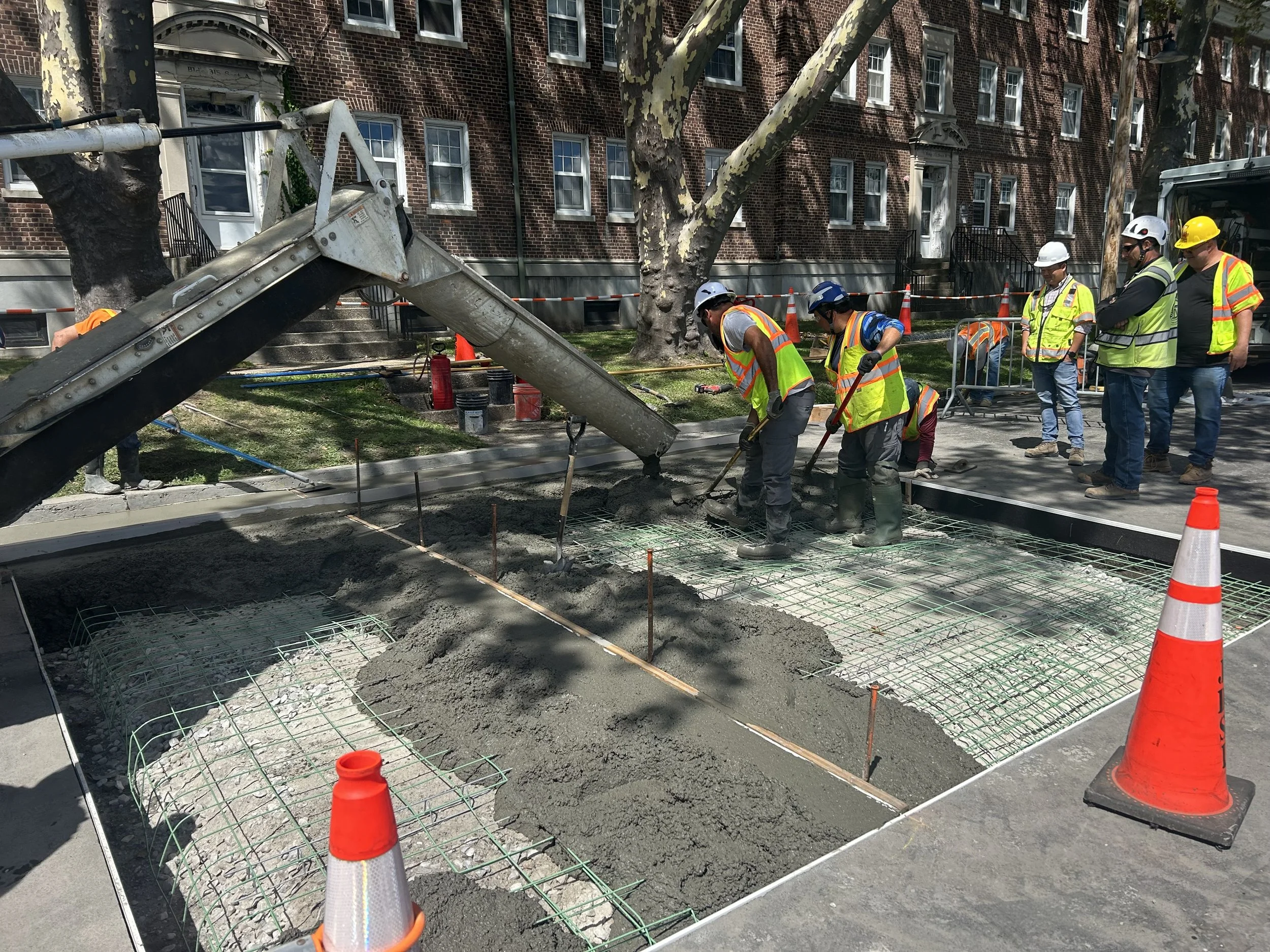
The New York Climate Exchange partnered with Skidmore, Owings & Merrill, Matthews Nielsen Landscape Architects, Skanska and the Trust for Governors Island to do a test pour of the Prometheus Materials bio-cement blend in August 2025.
The pilot, encompassing 10 cubic yards of paved roadway near Yankee Pier, evaluated a concrete mix that replaced 40% of conventional cementitious materials with ProZERO™. The team assessed compressive strength, constructability, installation conditions, and long-term durability under real-world conditions, including exposure to winter weather and routine maintenance. One key objective was determining whether the material could achieve a compressive strength of 4,000 psi at 28 days—the industry benchmark for many paving applications.
The results demonstrated both the promise of the material and the importance of real-world testing. While the pilot did not consistently meet the target strength at the standard 28-day testing interval, the material continued to gain strength over time and exceeded the required target during later testing. Following the pilot and design team review, ProZERO™ remains incorporated into the project’s Basis of Design for select hardscape applications. The next step is moving from a successful field demonstration to a repeatable construction process: working with Prometheus Materials, construction partners, and batch plant operators to develop a controlled, engineered mix that can consistently meet project specifications at scale.
Collaboration with the Trust for Governors Island was crucial to testing whether the material could move beyond a promising idea and into everyday construction. Others across the city are creating space for piloting and testing, such as BATWorks and the Mass Timber Studio, both operated by the NYC Economic Development Corporation's Green Economy team.
The ultimate goal extends beyond this single pilot. More than 30 billion tons of concrete are produced globally each year, making it one of the world’s most widely used construction materials. Even modest reductions to the carbon footprint of concrete can have an enormous impact when adopted at scale. Because ProZERO™ incorporates algae, it has the potential to bring a carbon-absorbing building material to the market.
Through the development of its future campus and broader innovation programs, The Exchange will continue partnering across the built environment to identify barriers, generate real-world performance data, and create pathways for climate solutions to move into standard practice. Collaboration between project owners, designers, contractors, manufacturers, and public agencies to test, refine, and ultimately adopt new building materials is key. The true measure of success isn’t the pilot itself, but whether the lessons learned can help low-carbon materials move from promising innovations to everyday use across New York City and beyond.
Check out the Technical Report on the low-carbon concrete pilot with Prometheus Materials to learn more.