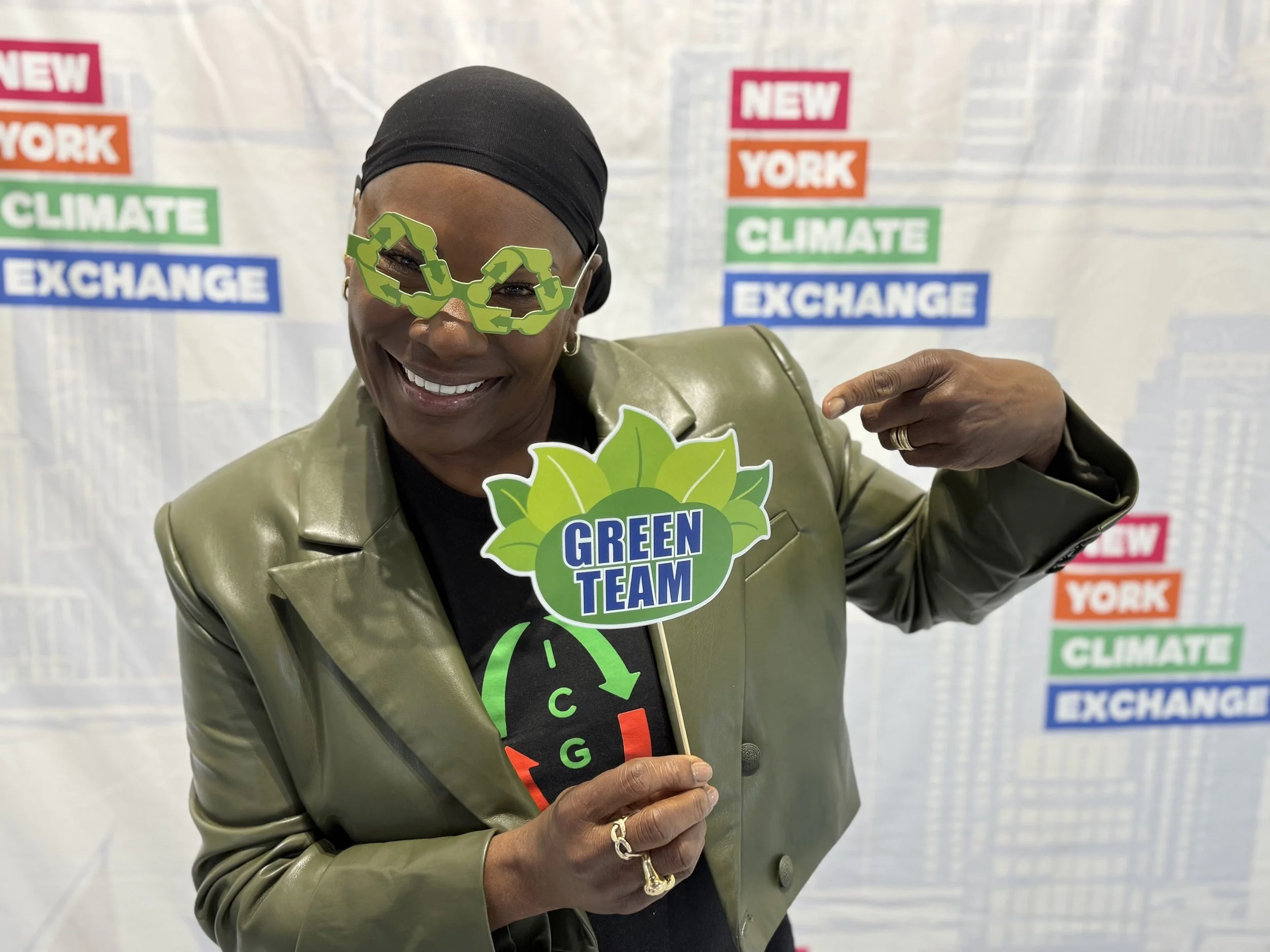
Founder
She/Her
For over a decade, Brigitte led the fight for herself and fellow residents in her Right to Recycle Collection Initiative within her NYC public housing community. She founded ICGT after discovering that NYCHA's recycling program was nonexistent. She envisioned a convenient way for residents to recycle, create green jobs in communities with some of the highest unemployment rates, and increase civic engagement.

As a teen, Brigitte observed her mother’s passion for caring about her community and witnessed its effects on others, to this day. Brigitte calls this work a “green ministry” and wants others to develop the utmost respect for our only home and its life-giving power.

In 2018, she won an international competition for solutions to improve recycling in NYC public housing (NYCx Co-Lab Challenge) to increase recycling rates at a NYCHA development in Brownsville, Brooklyn.  Having won the NYCx Co-Lab Challenge: Zero Waste in Shared Space, the pilot project was launched, and Vicenty was honored at the Zero Waste in Shared Space recognition ceremony. Her work has been featured in a multitude of journalistic and media platforms.
Brigitte Charlton-Vicenty
Full Transcript
INTRO
This is The Climate Story Project— where we share real stories about how climate change is shaping our lives. Stories that connect us. Stories that move us to act. This is a project of the New York Climate Exchange, a non-profit organization that’s accelerating climate solutions through a unique partnership model and climate campus on Governors Island. In each episode, you’ll hear voices from different places and walks of life in our growing archive of personal climate stories, so that we can remember, reflect, and respond together.
The story you’re about to hear is from Brigitte Charlton Vicenty. Brigitte is the founder of Inner City Green Team and a recipient of the 2025 NYCHA Resident Climate Action Grants, a program of the Public Housing Community Fund and the New York Climate Exchange.
BRIGITTE
I've been an environmentalist since I was eight years old. My mommy kept me from school one day and we got in the car and we went upstate. And I saw the foliage. I'm sure I saw the foliage when I'm in the city and, you know, noticed it, but not noticed it and you know, the magnificence of going upstate and seeing all these colors. It's just a beauty. Just mother nature pulling up a skirt and saying, “Look how pretty I am!”
I still remember my memory of like, just being just, in awe of the beauty. And right then, I wanted to protect this. The feeling that it gave, it just made me feel like I wanted to protect it. So I can continue to see this. I want to be a part of this. I want to help, like it helps us. You know, nature gives us life, and I wanted to do a give back. And be a good steward.
I was born in New York and in my youth, you know, it reached a hundred degrees, but not as often. It was like a real phenomenon. But now, you know, the frequency of it. And just having these short winters. I always observe the trees, when the trees start to bud. And they are so confused, that you see them budding in February. And the squirrels are out all year round. Seeing Mr. Squirrel out in November, “You supposed to be hibernating somewhere.” He's like, “I'm out here with you.” You see flies out year round now. Before it was like, “Oh hey, the bugs are gone. Yes!” And the flies are still here. The squirrels are still squirreling. And, of course, the violence of the storms. It's just like Mother Nature has an attitude. She's not happy. She's not happy with us and she's letting us know about it. She needs some serious housekeeping.
In 2011, I discovered that the largest public housing authority in America was not recycling. The bins had been outside the building for a few years and I had been putting my recyclables in the bin. And a boy– you know, they use it as a seat, you know, hanging out in front of the buildings– he was sitting on the bin and he was like, “I don't know why you keep putting the recyclables in there. They’re just throwing them in the trash.” And I'm like, you know, the first is denial. It’s like, “No, no, that's not true.” He’s like, “Yeah, it's true.” And I was like dumbfounded at that point, and I wanted to find out why. And the next day I literally saw my recyclables being put in a black plastic bag. I was flabbergasted is the word that I always use. My neighbors and the whole NYCHA wide community thought that we had been part of the, you know, recycling program and following the recycling laws and doing our civic duties, and they were just simply throwing it in the trash because they had no solution on how to.
That was my moment of obligation. So I wanted to know why, and they had to answer the question. Me as a resident, they had to answer to why this was happening. I had to push so much, and they resisted so much until I filed a lawsuit with the Natural Resource Defense Counsel to get them to come into compliance with the recycling law. We just continued to try to get approval to get into NYCHA developments to provide this service to communities that were, again, marginalized, underserved, again. You know, here we go, when it comes to everything, it's always, you know, we're the last. You know, one of the things that they would say is that, “They don't want to do it” like residents don't want to recycle. But if you don't know how, if you're not giving us the tools, we won't be able to do it efficiently as it needs to be done. This is definitely a skill that needs to be learned. It's an easy skill, but it is a skill all the same.
So fast forward, I've been able to implement a recycling education program within NYCHA development to increase resident engagement, create green collar jobs, and improve civic engagement when it comes to sustainability. We teach residents, educate residents on recycling. Train them to collect the recyclables at residents’ door. They don't have to walk outside. There's a huge senior population, there's a huge population of people with disabilities, mobility issues. People can't get to those bins. If the bin is all the way, you know, 200 feet away, you have to get in the elevator and then go out. It's cold. It's a hundred degrees. They're not gonna do it. But you can recycle in your underwear with our program. So there's no excuse. And if I say, “Hey, would you like to learn to recycle?” Just, you know, hear me out. Why wouldn't you want to save the world? You know, become nature's housekeeper. Why wouldn't you?
Mentally, I think people get conditioned. They think someone else is supposed to take care of it. Instead of, you know, them being the ones to take care of it. Pick that up, you know. This is about empowerment and people need to be empowered to change their habits and change the way they think. You know, it's everyone's job 'cause we all are here. You know, if you don't want to do this for you and you don't think you should do this for you, do it for your babies. Do it for the ones that are coming up. If you can't find a reason, do it for them. This is what I call my green ministry, and I'm here to preach the gospel of becoming a steward and pay your rent. Pay your rent by servicing our planet. That's the rent that you should be paying.
OUTRO
This story is part of The Climate Story Project. To find more stories and learn more about The New York Climate Exchange, visit nyclimateexchange.org and follow us on LinkedIn and Instagram. This episode was produced by Kylie Miller. Thanks for listening.